


Agency is an essential ingredient for thriving in and transforming the world. However, it often isn’t a centerpiece of young children’s experiences in school.
This resource seeks to help schools and districts rethink and redesign learning so that all learners, including our very youngest and most marginalized, are able to enact their agency and recognize their power.
Schools must focus on nourishing, not extinguishing learners’ curiosity and motivation; agentic learning is a step in this direction.

Agency must be a part of all learners’ lives in order to move toward a more just, inclusive, and equitable future.

Agency involves a variety of skills; young children are capable and ready to start building these skills and enacting their agency.

Agentic classrooms enable young people to act on their curiosities, an opportunity that is too often lost for children when they transition to school and can support engagement and learning.

Agency fuels lifelong learning and achievement and is vital for navigating the challenges of a complex, uncertain future.
Agency entails intentionally influencing one’s life and learning. This process relies on an individual’s capacity and motivation as well as the context they are in.
Agency is the ability to intentionally influence one's life and learning.
It entails a continuous and dynamic process of setting goals, making plans to achieve those goals, taking action, and reflecting and revising along the way.
People are more likely to exhibit agency when they are motivated, have the required capacity, and are situated in a supportive context.
There are a variety of ways to cultivate agency in early grades. We have identified ten practices that align with the research on agency and K–2 development and with what forward-thinking schools are doing to support agency in their youngest learners.
- Safe & Trusting Culture
- Shared Ownership of Physical Environment
- Rigorous Academic Learning
- Learning Strategies & Habits Instruction
- High-Value Learning Activities
- Play
- Focus on Goals, Progress & Mastery
- Metacognitive Reflection & High-Quality Feedback
- Deep, Self-Directed Work
- Targeted Support
Agency is the ability to intentionally influence one's life and learning.
It entails a continuous and dynamic process of setting goals, making plans to achieve those goals, taking action, and reflecting and revising along the way.
People are more likely to exhibit agency when they are motivated, have the required capacity, and are situated in a supportive context.
There are a variety of ways to cultivate agency in early grades. We have identified ten practices that align with the research on agency and K–2 development and with what forward-thinking schools are doing to support agency in their youngest learners.

Redesigning learning to advance agency in early grades will be a significant change, one that requires fundamental shifts to your school and system. Luckily, there are others to learn from and with.
Examples
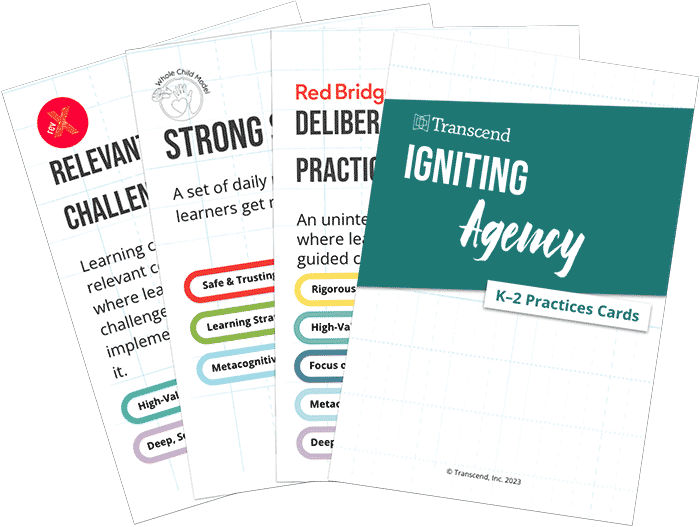
The Igniting Agency K–2 Practices Cards are intended to spark inspiration and conversation about advancing agency in early elementary learning. Each card shares an example with the agentic practices it leans into on the front and a short description of the example on the back. Additionally, each agentic school practice has an “overview” card that provides a more in-depth description of the practice and its alignment to the three drivers of agency.